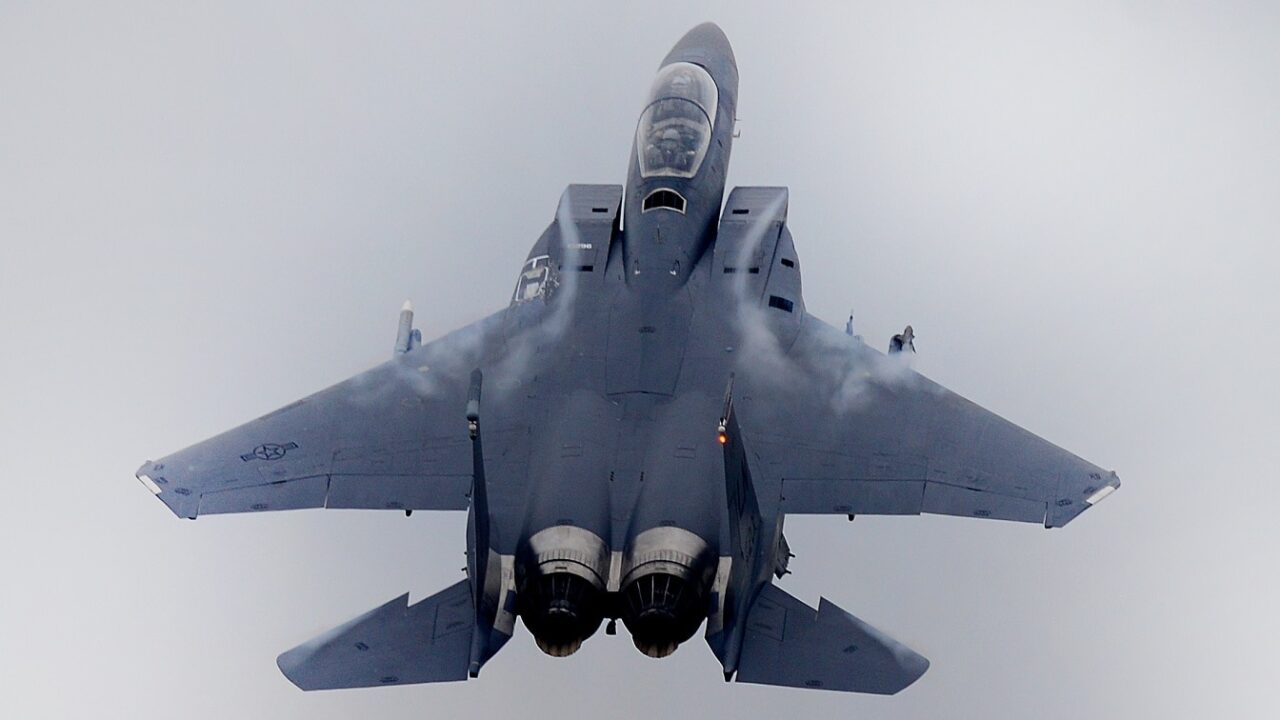
The landscape of modern military aviation is constantly evolving, not just in terms of technological advancement but also in the intricate economics of procurement. For decades, the Lockheed Martin F-35 Lightning II has been synonymous with cutting-edge, yet undeniably high, costs. Meanwhile, the Boeing F-15 Eagle, a legendary air superiority fighter, has received a new lease on life with its advanced F-15EX Eagle II variant, promising a powerful and potentially more cost-effective alternative. But a surprising shift is underway: recent data suggests that the "flyaway" price of the F-15EX might now be exceeding that of the F-35A. This raises a crucial question for defense planners and taxpayers alike: is the F-15EX Eagle II now more expensive than its fifth-generation counterpart?
The Shifting Sands of Fighter Jet Procurement: F-15EX vs. F-35A Flyaway Costs
For many years, the F-35 Lightning II was widely perceived as the most expensive fighter jet on the market, a perception solidified during its early development and production phases. Its advanced stealth capabilities, sensor fusion, and networking prowess came with a hefty price tag. However, as production has ramped up globally, benefiting from economies of scale and maturing manufacturing processes, the F-35A's per-unit "flyaway" cost has steadily decreased. Simultaneously, the F-15EX Eagle II, an evolution of a venerable design, has seen its price climb.
When considering the F-15EX Eagle II price, it's important to differentiate between various cost metrics. The "flyaway" price refers to the cost of the aircraft itself, without additional mission-specific equipment or lifetime support. For the F-15EX, this figure has fluctuated with each production lot and contractual negotiation:
- Lot 2: Approximately $90 million per jet.
- Lot 3: Rose to around $97 million per jet.
- Lot 4: Saw a slight decrease to roughly $94 million per jet.
These figures place the F-15EX in a price bracket that, remarkably, often surpasses the current flyaway cost of an F-35A. The F-35A's flyaway cost has dipped into the low $80 millions and even below for some recent production lots, a significant achievement for a fifth-generation stealth aircraft. This unexpected crossover in F15 Jet Kosten challenges conventional wisdom and underscores the dynamic nature of defense procurement.
Beyond the Bare Bones: What Drives the F-15EX's Full Combat Price Tag?
While the flyaway cost provides a baseline, it paints an incomplete picture. A "naked" F-15EX, while an impressive airframe, isn't truly combat-ready without its full suite of mission-critical systems. To understand the comprehensive F15 Jet Kosten for a fully equipped, battlefield-capable aircraft, additional systems must be factored in. These include:
- EPAWSS (Eagle Passive/Active Warning and Survivability System): A sophisticated electronic warfare suite crucial for detecting, identifying, and countering threats.
- Targeting Pods: External pods that house advanced sensors for precision targeting, such as the AN/AAQ-33 Sniper Advanced Targeting Pod or the AN/ASQ-236 DRAGON targeting pod.
- Infrared Search and Track (IRST) Sensors: Passive systems that detect heat signatures, offering a stealthy way to track enemy aircraft, especially in radar-denied environments.
When these vital components and others are integrated, the price of a single F-15EX can climb significantly, reaching up to approximately $117 million US dollars. This jump from the flyaway price highlights that initial acquisition figures can be misleading without context. A three-jet order, for instance, could range from $270 million to $291 million depending on the specific lot and level of equipment. Therefore, when discussing F15 Jet Kosten, it's crucial to clarify whether one is referring to the basic airframe or a fully missionized platform.
Unpacking the "Warum?": Factors Inflating F-15EX Costs
The upward trend in the F-15EX's price is not arbitrary; it's a confluence of several significant factors impacting the defense industrial base:
- Inflation and Economic Headwinds: The global economic climate, particularly in recent years, has seen persistent inflation. This affects raw material costs, energy prices, and transportation, all of which feed into the final cost of complex manufacturing products like fighter jets.
- Supply Chain Disruptions: Post-pandemic, global supply chains have faced unprecedented challenges, leading to shortages of critical components and materials. These disruptions often result in delays and increased costs as manufacturers seek alternative suppliers or pay premiums for expedited delivery.
- Labor Shortages: The highly specialized defense industry requires a skilled workforce. Shortages of qualified engineers, technicians, and manufacturing personnel can drive up labor costs and slow down production.
- Advanced Systems Integration: The F-15EX isn't just an old F-15 with new paint. It integrates state-of-the-art avionics, a powerful active electronically scanned array (AESA) radar, advanced electronic warfare systems like EPAWSS, and a modern open mission system architecture. These cutting-edge components, especially when integrated seamlessly from the factory, add substantial value and cost.
- Production Lot and Negotiation: Military contracts are typically structured into production lots. The negotiated price for each lot can vary based on the quantity ordered, the economic climate at the time of negotiation, and specific requirements from the buyer. Smaller, more frequent production runs for the F-15EX (compared to the F-35's massive global production) mean fewer opportunities for significant economies of scale.
These factors explain why the F15 Jet Kosten have moved from below $80 million in earlier variants to the current $90-100+ million range for the F-15EX. The F-15EX is a new production line, meaning it hasn't benefited from the decades of sustained, high-volume production that helped drive down the cost of earlier F-15 versions, nor the aggressive cost-reduction initiatives seen with the F-35 as it matured.
The True Cost of Air Superiority: Lifecycle Expenses Overwhelm Acquisition
Focusing solely on the acquisition price of a fighter jet, whether it's the F-15EX or the F-35A, provides only a fraction of the total economic picture. In strategic defense planning, the initial purchase price is often dwarfed by the expenses incurred over the aircraft's entire operational lifespan. This "lifecycle cost" is a critical metric that includes:
- Maintenance and Sustainment: Regular inspections, repairs, spare parts, and overhauls. Modern aircraft are incredibly complex, requiring specialized tools and highly trained personnel.
- Fuel and Consumables: The cost of jet fuel, lubricants, and other expendables over tens of thousands of flight hours.
- Upgrades and Modernization: Throughout its decades of service, an aircraft will receive numerous software and hardware upgrades to remain competitive against evolving threats.
- Training: The extensive cost of pilot training, ground crew training, and simulator operations.
- Personnel: The salaries and benefits for all personnel involved in operating and maintaining the fleet.
For an aircraft with an expected service life of 40-50 years, these recurring costs can easily exceed the initial purchase price by several multiples. This is particularly true for older designs like the F-15, which might require more intensive maintenance as they age, even with new components. The discussion around F-15EX total cost often highlights that without considering these long-term expenses, any comparison based purely on flyaway price is fundamentally misleading for policymakers and the public. Understanding the full scope of F15 Jet Kosten requires looking far beyond the showroom floor.
Strategic Implications and Future Outlook
The shifting cost dynamic between the F-15EX and F-35A carries significant strategic implications. Despite the F-15EX's increasing flyaway cost, the U.S. Air Force continues to procure both types of aircraft, albeit for different, complementary roles. The F-35, with its stealth and advanced sensor fusion, is designed to be the "quarterback" – penetrating contested airspace and gathering intelligence. The F-15EX, on the other hand, is envisioned as a "missile truck" – a powerful, fast, and high-payload platform that can carry a large arsenal of weapons, operating in less contested environments or alongside stealth assets to overwhelm adversaries. Its incredible speed and range also make it invaluable for specific missions.
For international customers, the cost comparison becomes even more complex, factoring in geopolitical considerations, specific mission requirements, and interoperability with existing fleets. The F-15EX offers commonality for nations already operating F-15s, potentially reducing training and logistical hurdles, even if the initial F15 Jet Kosten are higher than anticipated. The F-16 Block 70/72 Fighting Falcon, also in production for export, presents another highly capable, though non-stealthy, option for global partners, further diversifying the market for advanced non-stealth fighters.
In conclusion, the assertion that the F-15EX Eagle II's flyaway cost has now surpassed that of the F-35A is a testament to the complex and often counter-intuitive economics of modern defense procurement. While the F-35's cost has trended downwards due to massive production volumes, the F-15EX's price has been influenced by inflation, supply chain issues, and the integration of cutting-edge technology into an existing airframe. However, focusing solely on the "price per jet" is a simplistic view. The true F15 Jet Kosten, like that of any advanced military aircraft, is a multifaceted calculation that extends over decades, encompassing acquisition, maintenance, upgrades, and operational expenses, collectively defining the immense investment required for air superiority.